

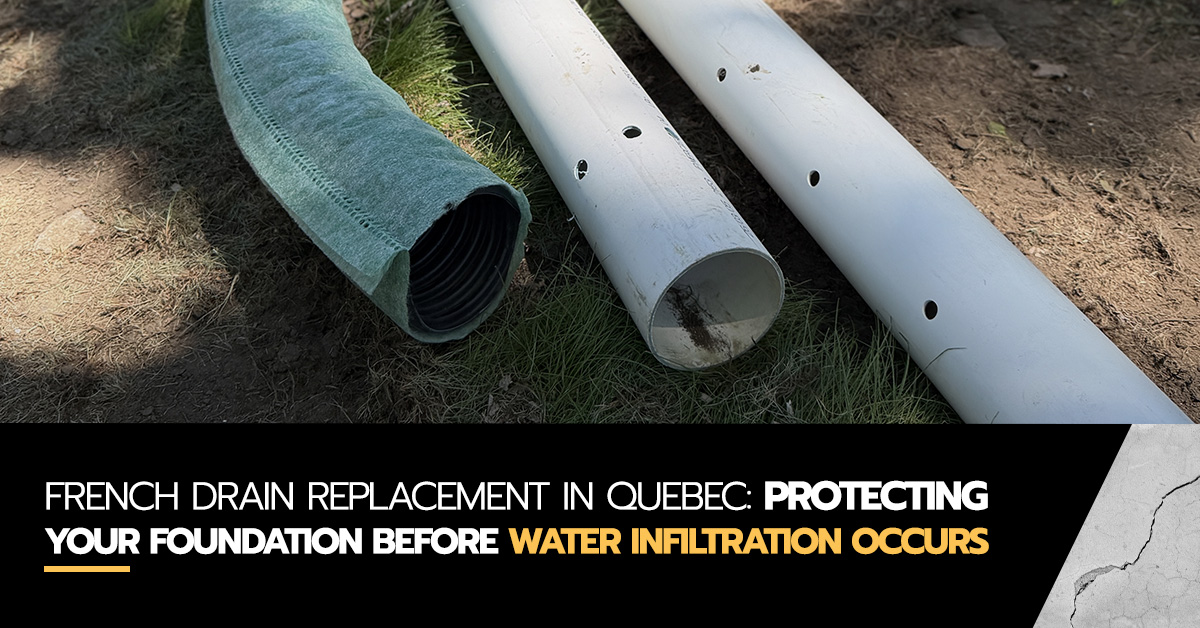
French drain replacement in Quebec often becomes a priority when a basement starts showing signs of humidity, water infiltration, or pressure around the foundation. After a rainy spring, a rapid snowmelt, or several freeze-thaw cycles, water can accumulate around the home and reveal a problem that had been hidden until then. For a homeowner, this is rarely a small decision: you want to understand the steps, the timeline, and the real budget before excavating around your house.
At Les Fondations Nouvelle Génération, in Saint-Zotique, Quebec, the goal is simple: help homeowners regain a drier, more stable, and better-protected foundation. Our services include interior and exterior French drains, foundation waterproofing, crack repair, camera inspections, and solutions related to iron ochre.
French drain replacement in Quebec: why this is an important project
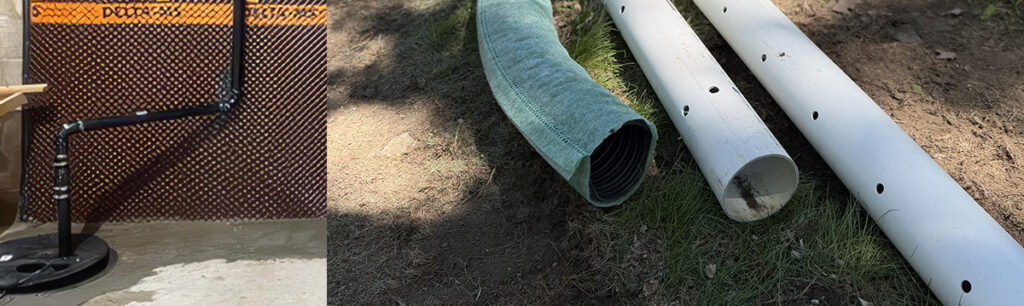
A French drain is designed to collect water around the foundation and direct it toward an appropriate drainage point. When it works properly, it does its job quietly underground. You almost never think about it. But when it is clogged, collapsed, poorly installed, or too old, water can remain against the foundation walls and increase the risk of water infiltration.
In Quebec, this type of problem is common because homes must deal with demanding conditions: snow, rain, saturated soil, sudden thaws, freezing, thawing, and springs that can be very wet. The APCHQ reminds homeowners that perimeter drainage around foundations is a basic strategy for reducing damp basement problems, and that perimeter drains must notably have a minimum diameter of 4 inches, or 100 mm, with crushed stone around the drain.
This is not only a matter of comfort. Proper drainage protects the structure, limits humidity, and helps prevent more expensive repairs.
Signs that a French drain should be inspected
A failing French drain is not always visible to the naked eye. Very often, the signs inside the home speak first.
You should request an inspection if you notice:
- water at the bottom of the basement walls;
- a persistent damp smell;
- whitish stains on the concrete;
- a wet crack;
- a sump pump that runs too often;
- mold;
- a cold or damp floor;
- water accumulation near the foundation;
- a drain that may be clogged by roots, sediment, or iron ochre.
Iron ochre deserves special attention. It can create orange deposits and clog drainage systems, preventing water from flowing properly around the foundation. Les Fondations Nouvelle Génération offers solutions for this type of situation, especially when a French drain is affected by buildup that reduces its effectiveness.
Camera inspection: see before you dig
Before replacing a French drain, its condition must be confirmed. A camera inspection makes it possible to see whether the drain is clogged, cracked, crushed, poorly sloped, or contaminated. This is a very useful step because it helps avoid moving too quickly toward a full excavation project when cleaning or a targeted intervention may be enough.
In some cases, the drain is simply obstructed. In others, it is too damaged to keep doing its job. The camera helps distinguish between the two. This is often when the homeowner gets a clearer understanding of the real foundation repair cost: the price rarely depends on a single element, but rather on the overall condition of the drainage system, the foundation, the soil, and the site access.
The steps involved in French drain replacement
1. Assessing the property and symptoms
Everything starts with reading the building. Where is the water coming in? Does the ground slope toward the house? Is there a visible crack? Is the basement finished? Is the sump pump effective? Does water always return to the same place after heavy rain?
This first step makes it possible to establish a realistic plan adapted to the home and the property.
2. Excavation around the foundation
Exterior French drain replacement generally requires excavation down to the base of the foundation. This is the most visible stage of the project. Soil is removed around the home to access the old drain and the foundation walls.
In a residential neighborhood, this step can be simpler if access is clear. It becomes more complex when crews must work around a deck, balcony, asphalt driveway, fence, trees, window wells, or landscaping.
3. Removing the old drain
The old drain is removed or decommissioned depending on the condition of the existing system. At this stage, it becomes possible to see exactly what was causing the problem: clogged drain, improper slope, crushed pipe, sediment buildup, or iron ochre.
4. Cleaning and checking the foundation walls
Once the foundation is exposed, the walls are cleaned. This is the right time to check for cracks, weakened areas, and water entry points. Les Fondations Nouvelle Génération also provides foundation crack repair, especially when humidity or water infiltration is related to openings in the concrete.
5. Waterproofing the foundation
French drain replacement is often paired with exterior waterproofing. It makes sense: while the foundation is already exposed, it is best to protect the walls before backfilling. Les Fondations Nouvelle Génération offers waterproofing services for residential and commercial foundations, with solutions designed to keep foundations more stable, dry, and protected against water.
6. Installing the new drain
The new drain is installed at the proper level, with the right slope and appropriate materials. It must allow water to flow efficiently toward its drainage point. The APCHQ specifies that perimeter drains must be covered with crushed stone on the sides and on top, which helps water reach the drain while reducing the risk of clogging.
7. Backfilling and site restoration
Once the drain is installed and the foundation is protected, the area is backfilled. Final grading is important: if the soil directs water back toward the home, the problem can return. A good drainage project is not limited to the underground pipe. It also takes into account the slope of the land, downspouts, and surface water management.
Les Fondations Nouvelle Génération in Saint-Zotique: a local and practical approach
Located in Saint-Zotique, in the Vaudreuil-Soulanges region, Les Fondations Nouvelle Génération works in an environment well known to local homeowners: family homes, residential properties, finished basements, wet springs, and proximity to Lake Saint-François. The City of Saint-Zotique is located in Montérégie, in an area known for its proximity to Lake Saint-François and its residential lifestyle.
When you live in this kind of setting, your home is not just an address. It is where you return after work, where children play in the basement, where winter equipment, bikes, tools, and family memories are stored. A water problem disrupts that peace of mind. That is why a well-planned intervention can make a real difference.
How much time should you expect for the work?
The timeline depends on the perimeter to be excavated, the depth of the foundation, the weather, the soil condition, and any additional work required. For a typical home, French drain replacement can often be counted in days, but a more complex project may take longer.
Obstacles can significantly affect the timeline: a patio to remove, a driveway to protect, limited access, difficult soil, cracks to repair, a membrane to install, a sump pump to add, or the presence of iron ochre. A proper schedule can therefore only be confirmed after the property has been assessed.
Realistic costs for French drain replacement in Quebec
The price of French drain replacement varies greatly. There is no single price that applies to every home. Public price ranges can, however, provide a useful starting point.
In Quebec, Soumission Rénovation often estimates a French drain installation or replacement project between $15,000 and $25,000, with significant variation depending on the site. RénoAssistance, for its part, mentions a range of approximately $18,000 to $24,000 for a typical bungalow, including a waterproofing membrane, with an estimate of around $180 to $240 per linear foot depending on the obstacles and project parameters.
These amounts should be viewed as benchmarks, not a price guarantee. The final cost depends on several factors, including:
- the number of linear feet to replace;
- the depth of the foundation;
- accessibility around the home;
- the type of soil;
- the presence of water;
- the number of cracks to repair;
- the waterproofing work required;
- the sump pump;
- the window wells;
- the presence of iron ochre;
- site restoration.
That is why a personalized quote remains essential. It makes it possible to know what is included, what is not, and which steps are truly necessary.
Replace, repair, or clean?
Not all drainage problems automatically require a full replacement. A clogged drain can sometimes be cleaned. A localized crack can sometimes be repaired without redoing the entire perimeter. But if the drain has collapsed, was poorly installed, is saturated with iron ochre, or can no longer evacuate water, replacement often becomes the more durable option.
The right reflex is to inspect before deciding. It is more reassuring, more precise, and often more cost-effective in the long run.
Protect your foundation before water gains ground
A damp basement generally does not improve on its own. Water finds weak points: a crack, a joint, a tired drain, or an unfavorable slope around the property. The longer you wait, the more the damage can spread.
With Les Fondations Nouvelle Génération, you can request an assessment, ask your questions, and receive advice adapted to your home. Whether you are in Saint-Zotique, Vaudreuil-Soulanges, Montreal, Laval, on the South Shore, or in the surrounding areas, our team can help you better understand the condition of your foundation and choose the right solution. Our services include French drains, waterproofing, crack repair, and several specialized foundation-related services.
For a drier home, a healthier basement, and long-lasting peace of mind, the right time to act is before water settles in.
FAQ – French drain replacement in Quebec
1. When should a French drain be replaced?
Replacement should be considered when a drain is broken, crushed, poorly sloped, severely clogged, or unable to evacuate water. A camera inspection can confirm its condition before planning the work.
2. How much does French drain replacement cost in Quebec?
Public price ranges often fall around $15,000 to $25,000, or approximately $180 to $240 per linear foot for certain typical projects. The real price depends on the property, access, foundation, and related work.
3. Is waterproofing necessary with a new drain?
Often, yes. When the foundation is already excavated, it makes sense to assess wall waterproofing before backfilling. This helps reduce the risk of future water infiltration.
4. How long does the work take?
For a typical home, the work can take a few days. The timeline varies depending on the weather, site access, depth, obstacles, and repairs required.
5. Does a clogged drain always need to be replaced?
No. A clogged drain can sometimes be cleaned. Replacement becomes more relevant if the drain is damaged, collapsed, contaminated, or ineffective despite cleaning.